




news
Environment
Results 41 - 60 of 173.
Environment - 09.05.2024
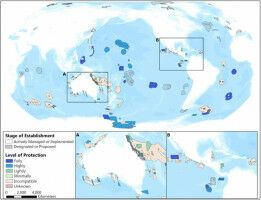
Marine Protected Areas (MPAs) are designed to ensure the long-term conservation of marine ecosystems and the services they provide to human societies; however, only a third of these areas are capable of offering real protection on a global scale. These are the findings of a study, carried out by scientists from the CNRS 1 as part of an international research team, to be published on 9 May in Conservation Letters .
Health - Environment - 02.05.2024

A new study involving INRAE reveals the speed at which bird flu is spreading in live poultry markets in Asia. Scientists from the One Health Poultry Hub program have modeled the spread of avian flu in these markets, integrating for the first time biological data collected in the field. They focused their study on the H9N2 avian flu virus, which is not very virulent for poultry, but represents a major risk in the spread and evolution of the disease.
Environment - Agronomy & Food Science - 23.04.2024

How can we know what chickens are feeling? An INRAE research team were able to uncover various degrees of redness on chickens' faces depending on their emotional state, while, at the same time, demonstrating that the skin of chickens that were used to humans stayed lighter in colour, thereby indicating a calmer state when humans were nearby.
Environment - Earth Sciences - 18.04.2024
The Earth, precariously balanced
Aerial view of slash-and-burn agriculture in the state of Amazonas, western Brazil (September 2022). On our planet, everything is interconnected, from terrestrial and marine ecosystems and biodiversity to ice sheets, rivers and oceans. But a recent report reveals that the dynamics of these different systems is being destabilised by human activities to such an extent that they are reaching points of no return.
Environment - Earth Sciences - 10.04.2024

An international consortium of paleontologists, geologists and biologists describes the discovery of fossil assemblages spanning the last 130,000 years beneath the Ariane 6 rocket launch site in Kourou, French Guiana. The consortium, coordinated by scientists from the Montpellier Institute of Evolutionary Sciences (Université de Montpellier/CNRS/IRD) and the Université de Guyane/Géosciences Montpellier, includes Frédéric Quillévéré from the Laboratoire de Géologie de Lyon : Terre, Planètrs, Environnement (LGL-TPE, CNRS/Université Lyon 1/ENS de Lyon/Université Jean Monnet).
Environment - Agronomy & Food Science - 26.03.2024

INRAE, Bordeaux Sciences Agro, CNRS, Université de Bordeaux and Université de Bourgogne have analysed trends to come in current and developing winegrowing regions around the world to adapt wine production to climate change. The results of the study, published in Nature Reviews Earth and Environment, show that some 90% of coastal and low-altitude regions in southern Europe and California may no longer be able produce good wine in economically sustainable conditions by the end of the century if global warming exceeds +2°C.
Life Sciences - Environment - 29.02.2024

What is the origin of genetic diversity in plants? Can new mutations acquired during growth be passed on to seeds? INRAE scientists, in collaboration with CIRAD and the CNRS, have used the French Guiana forest as the setting for their research, leading to a series of discoveries on this fundamental question in biology.
Environment - Agronomy & Food Science - 28.02.2024

The scientific community has been sounding the alarm over the effects of pesticide use on human health and the disappearance of numerous species in agricultural environments for half a century. As early as 1962, Rachel Carson's pioneering work predicted "silent springs" caused by the decline of birds, the collateral victims of pesticides via the poisoning of environments and the disappearance of insects.
Environment - Agronomy & Food Science - 20.02.2024
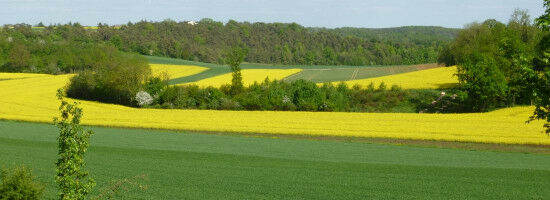
Researchers at INRAE analysed the market and non-market impacts of the European Green Deal on the European agrifood system. Substantial positive impacts on the climate, the environment and public health require simultaneous action on agricultural production, food losses and waste, and eating patterns.
Paleontology - Environment - 09.02.2024

A new fossil deposit has been unearthed in the Hérault region thanks to the long-term work of a couple of amateur paleontology enthusiasts, whose discoveries have been studied by an international team involving scientists from the CNRS (1) and the University of Lausanne. With over 400 fossils dating back 470 million years, the Cabrières site near Pézenas bears witness to the closest environment ever observed to the South Pole at that time.
Environment - 26.01.2024

An INRAE study conducted in collaboration with the University of Minnesota reveals global disparities between current and attainable agricultural yields, underscoring the importance of optimising agricultural practices by 2050 in the face of growing global demand. The researchers highlight crop growth potential for several crops, including maize, cassava and sorghum, and warn that rice yields could stagnate in Asia.
Environment - Agronomy & Food Science - 09.01.2024

Biodiversity-friendly livestock farms could be a real source of inspiration! Some positive news for the planet drawn from the conclusions of a study revealing how farm design and management can provide a window of opportunity for nature. Results published in the January 2024 issue of Agricultural Systems.
Environment - Earth Sciences - 06.12.2023

The ocean's capacity to store atmospheric carbon dioxide is some 20% greater than the estimates contained in the latest IPCC report 1 . These are the findings of a study to be published in the journal Nature on December 6, 2023, led by an international team including a biologist from the CNRS 2 . The scientists looked at the role played by plankton in the natural transport of carbon from surface waters down to the seabed.
Life Sciences - Environment - 01.12.2023

Beef currently accounts for 21% of the world's meat consumption, placing it third after poultry and pork. It therefore plays a crucial role in the global food system, with great economic and cultural importance in many countries. However, its production has a high environmental impact, mainly due to greenhouse gas emissions that contribute to climate change.
Environment - Agronomy & Food Science - 27.11.2023

A major breakthrough has been unveiled in Nature Communications, revealing the results of an in-depth study on the beneficial effect of temporal crop diversification in reducing pesticide use in France. These results, based on a detailed analysis of more than 14,000 observations, pave the way for an in-depth understanding of the links between temporal crop diversity and dependence on pesticides, be they fungicides, insecticides or herbicides.
Environment - Life Sciences - 21.11.2023

In the spring, Alpine glaciers sometimes don a sheer red or orangish veil. Known as 'red snow' or 'blood snow', this phenomenon is caused by the blooming of Sanguina nivaloides , a microscopic alga. Scientists from the CNRS, the French Alternative Energies and Atomic Energy Commission (CEA), Météo-France, INRAE, and Université Grenoble Alpes 1 turned their attention to this organism, which forms the pillar of a snowy ecosystem still poorly understood.
Environment - Life Sciences - 21.11.2023

In spring, Alpine glaciers sometimes turn a thin layer of red or orange. This phenomenon, known as "glacier blood", is due to the proliferation of a microscopic alga called Sanguina nivaloides . Scientists 1 from CNRS, CEA, Météo-France, INRAE and Grenoble Alpes University have been studying this organism, which forms the backbone of a little-known snow ecosystem.
Environment - 20.11.2023

PRESS RELEASE LED BY WESTERN SYDNEY UNIVERSITY - INRAE participated to a new research led by Western Sydney University's Dr Jürgen Knauer, Hawkesbury Institute for the Environment, published today [Saturday 18 November 2023 AEST] in leading international journal Science Advances paints an uncharacteristically upbeat picture for the planet.
Earth Sciences - Environment - 14.11.2023

Researchers from INRAE, Universidad del Desarrollo (Chile), University of Geneva and University of Grenoble developed a new method to assess the risk associated with rockfalls in the mountains, taking into account various triggering factors and all the issues exposed. They successfully tested it in the Chilean Andes.
Environment - Life Sciences - 10.11.2023

Unlike animals, plants have cells that are all surrounded by a strong wall. This protects them but also encloses them in a rigid skeleton. So how can they grow despite this wall? Scientists from INRAE and the CNRS, in collaboration with Swiss and Belgian teams, have now unlocked part of this secret.


