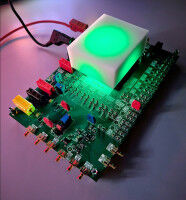
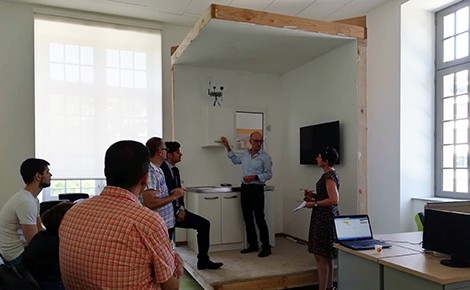
 © HUT Modular space within the Maison des sciences de l’Homme, showing a prototype installation. The floor is equiped with 16 pressure sensors per square meter, in order to monitor the occupants’ movements.
How can technology improve our housing conditions' How will we interact with “intelligent” housing? What information is it possible and desirable to share? What future legislative framework for these data is required? Organized by the CNRS, Montpellier University, and Paul Valéry Montpellier 3 University, the Human at Home (HUT ) project will look into these questions thanks to an “observatory apartment” that will be inhabited from October 2018. A member of the consortium, Montpellier Méditerranée Métropole is supporting this project, which is part of its Intelligent City approach. The HUT experiment is inaugurated in Montpelier on June 26, 2018. In autumn 2018, two volunteer students will move into an “observatory apartment,” which will be studied by around sixty researchers. The questions that these legal experts, economists, electronics engineers, computer scientists, architects, and specialists of language, behavior, marketing, and health are asking can only be explored in a meaningful way by studying a permanent living space. While they will not set foot in the apartment, the researchers will exploit the precious data produced by the “HUTmates. In practical terms, pressure sensors in the floors and movement sensors in some rooms will be used to evaluate the occupants' movements and actions in their living space.
POUR LIRE CET ARTICLE, CRÉEZ VOTRE COMPTE
Et prolongez votre lecture, gratuitement et sans engagement.
Vos avantages
- Accès à l'ensemble du contenu
- Recevoir des alertes pour les nouvelles et les offres d'emploi
- Publier des annonces